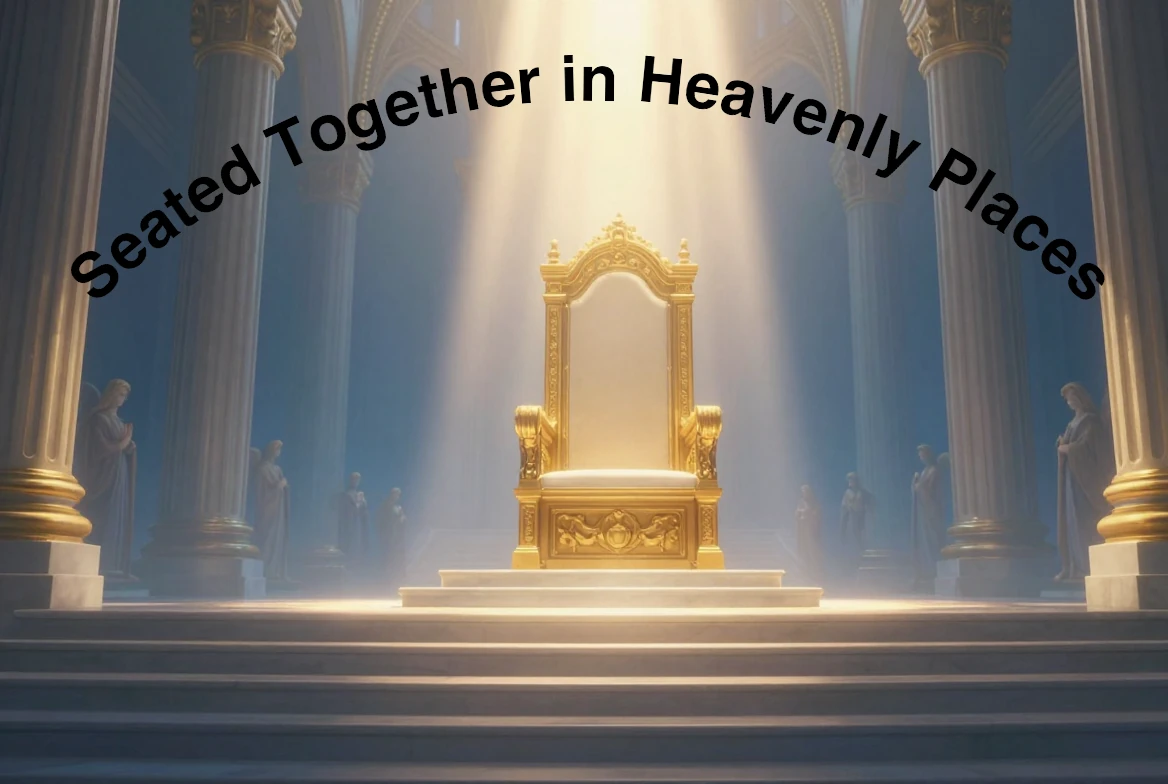
Few statements in all of Paul's writings are as staggering as this one, and few are read past as quickly:
"And hath raised us up together, and made us sit together in heavenly places in Christ Jesus." (Ephesians 2:6 KJV)
We are inclined to soften it into something manageable. Perhaps it means only that heaven is our destination — a statement of where we are headed. Perhaps it is just a figure for our new attitude, a posture of restfulness rather than striving. But Paul did not write that God will seat us, nor that we ought to feel seated. He wrote that God hath made us sit — an accomplished fact, already true of every believer, right now. The question is what that seat actually is. It is not our location, and it is not our posture. It is something far greater: our position in the risen Christ.
Not a Location, and Not a Posture
Start by clearing away the two smaller readings.
It cannot be a matter of physical location. The believers Paul addressed were walking the streets of Ephesus, and we are walking the streets of our own cities. No one is bodily in the heavenly places. The verse itself tells us why that misses the point, for it does not end where our summaries usually end. Read it again with its final words restored: God made us sit together in heavenly places — in Christ Jesus. Drop those three words and the sentence becomes a geography lesson. Keep them and it becomes the gospel. We are seated there not on our own account, and not by relocation, but in Him. The seat is His; we are in Him.
Neither is it merely posture — sitting as opposed to standing, a relaxed frame of mind. If Paul meant only an attitude, the words "together" and "in Christ Jesus" would be so much wasted breath. He is not describing how we feel. He is telling us where we have been placed.
So the seat is positional, and the position is union with Christ. This is the whole burden of the opening of Ephesians: not that we approach Christ, but that we are joined to Christ, so that what is true of Him is reckoned true of us. God "raised him from the dead, and set him at his own right hand in the heavenly places, Far above all principality, and power, and might, and dominion" (Ephesians 1:20–21 KJV) — and one chapter later He seats us in that same place, in Him. Paul says it another way in Galatians: "I am crucified with Christ: nevertheless I live; yet not I, but Christ liveth in me" (Galatians 2:20 KJV). We died with Him, we live with Him, and we sit with Him, because we are members of His body. The seat is not a reward we climb toward. It is the inheritance of everyone who is in Christ.
The Seat of a Finished Work
Why a seat at all? Because a seat is what one takes when the work is done. Paul is careful to show us the risen Christ already seated — the labor of the cross behind Him, nothing left to accomplish: "seek those things which are above, where Christ sitteth on the right hand of God" (Colossians 3:1 KJV). He is not standing to finish a task. He is seated because it is finished.
And we are seated in that finished work, lacking nothing:
"For in him dwelleth all the fulness of the Godhead bodily. And ye are complete in him, which is the head of all principality and power." (Colossians 2:9–10 KJV)
To be complete is to have nothing wanting. Out of Tradition Into Truth states it plainly: no water, no wafer, no ritual, no confession, and no ceremony "can increase the standing of one who is already seated with Christ in heavenly places." There is no higher shelf of grace to reach, no sacrament to top us up, no spiritual attainment that adds a cubit to a seat God has already given in full. That is what the seat means: not that our striving has succeeded, but that His work has. We were "made... accepted in the beloved" (Ephesians 1:6 KJV) — accepted, past tense, in Another. To sit is to rest in that.
The Seat Is a Throne: Rest and Rule
Yet the seat is not repose only. It would be a poor reading of Paul to make the right hand of God a place of mere restfulness, for it is the seat of government — the throne-side of the universe. Watch how Paul cannot mention Christ's session without heaping dominion upon it:
"...set him at his own right hand in the heavenly places, Far above all principality, and power, and might, and dominion, and every name that is named, not only in this world, but also in that which is to come: And hath put all things under his feet, and gave him to be the head over all things to the church." (Ephesians 1:20–22 KJV)
"The right hand," "far above all," "under his feet," "head over all" — this is not the vocabulary of a man reclining; it is the vocabulary of a King enthroned. To sit here is to reign. Paul's usage is consistent enough that even the great counterfeit is described the same way: the man of sin, in his blasphemous grasp at supreme authority, is one who "as God sitteth in the temple of God, shewing himself that he is God" (2 Thessalonians 2:4 KJV). To sit in that place is to lay claim to rule. Paul knows nothing of a seat of authority that is not also a seat of dominion; he even ranks created powers as "thrones, or dominions, or principalities, or powers" (Colossians 1:16 KJV), and sets a "judgment seat of Christ" (2 Corinthians 5:10 KJV) as the bench before which we answer.
Here is the wonder, then. Our seat is in Him, in the same heavenly places where He sits far above all — which means our position is not merely restful but elevated over the very powers we contend with. It is no accident that when Paul finally names our enemy he places him beneath our seat: we wrestle "against principalities, against powers, against the rulers of the darkness of this world, against spiritual wickedness in high places" (Ephesians 6:12 KJV) — the same ranks Christ is seated above, and we in Him. The seat is not, as Grace Ambassadors puts it, "just a lounge chair"; it is "a seat of authority and a position in Christ that He's granted you." Rest and rule meet at the right hand: it is the place where the finished work is enthroned.
But Paul is careful, and so must we be, about when that authority is put on open display. The seat is ours now; the reigning is held in reserve. He speaks of ruling and judging as things still ahead — "if we suffer, we shall also reign with him" (2 Timothy 2:12 KJV), "they which receive abundance of grace... shall reign in life by one, Jesus Christ" (Romans 5:17 KJV), "the saints shall judge the world... Know ye not that we shall judge angels?" (1 Corinthians 6:2–3 KJV). And when the Corinthians began to carry themselves as though the kingdom had already come in its fullness, Paul answered with holy sarcasm: "ye have reigned as kings without us: and I would to God ye did reign, that we also might reign with you" (1 Corinthians 4:8 KJV). The rebuke only lands because the open reign is not yet. So our authority follows the same pattern as our seat: possessed now, positionally, in Christ; exercised then, in the ages to come. We are enthroned in Him already, with a reign still before us.
A Heavenly Seat — and Why It Marks Us Off From Israel
The seat is located, but its location is heavenly. This is no small detail; it is the very thing that distinguishes the Body of Christ from Israel and her earthly hope. From his first words of blessing Paul lifts our portion off the earth entirely:
"Blessed be the God and Father of our Lord Jesus Christ, who hath blessed us with all spiritual blessings in heavenly places in Christ." (Ephesians 1:3 KJV)
Israel's covenants promised a land, a throne in Jerusalem, and a kingdom come down to the earth. Those promises are real, and God will keep them — but they were never ours. Paul reminds the Gentile believer that in time past he was "without Christ, being aliens from the commonwealth of Israel, and strangers from the covenants of promise" (Ephesians 2:12 KJV). We were not brought into Israel's earthly program; we were seated in Christ in a heavenly one. That is why Paul can say "our conversation is in heaven" (Philippians 3:20 KJV) — our citizenship, our commonwealth, is where our seat is.
Even the ages to come are measured differently for us. Paul's very next words after seating us are that "in the ages to come he might shew the exceeding riches of his grace in his kindness toward us through Christ Jesus" (Ephesians 2:7 KJV). It is a common thing to hear "the ages to come" pressed into Israel's kingdom hope. But Paul aims it at us — at the heavenly display of grace toward the Body of Christ. Our future, like our seat, is above.
A Seat You Did Not Earn and Cannot Lose
Because the seat is a finished work received in Christ, it is not held up by our performance — and this is where its comfort becomes unshakable. In Israel's covenant order a man's place among the people could rise or fall with his obedience. Not so here. Paul lays the whole doctrine of who we are in Christ before he ever turns to what we do, precisely so that we will never confuse the two. Our position is granted freely, on the ground of His blood and His election, and what we do does not determine who we are.
This is why the old scheme that secures a believer's "standing" by grace while making his daily "state" hang on confession and performance has no place at Paul's table. It cannot help but split the believer in two and smuggle a conditional, renewable forgiveness in through the side door — as though the seat were sure but the sitting had to be re-earned each day. Paul knows nothing of it. Our forgiveness is not a valve to be reopened; it is one act, total and finished:
"And you, being dead in your sins and the uncircumcision of your flesh, hath he quickened together with him, having forgiven you all trespasses." (Colossians 2:13 KJV)
All trespasses — not the trespasses up to conversion, with the rest left to a daily accounting. The same grace that seated us forgave us, once, entirely: "In whom we have redemption through his blood, the forgiveness of sins, according to the riches of his grace" (Ephesians 1:7 KJV). A seat secured by so complete a forgiveness cannot be forfeited by the one who sits in it, because he did not win it and does not maintain it. He was placed there, and there he remains — sealed until the day of redemption, his life "hid with Christ in God" (Colossians 3:3 KJV).
Sit Before You Walk, and Before You Stand
One guard keeps this truth from being mistaken for idleness. Ephesians moves in an order, and the order is deliberate: we sit before we are ever told to walk (Ephesians 4:1), and we walk before we are told to stand (Ephesians 6:11). The seat comes first. Everything Paul asks of us afterward — the worthy walk, the armored stand against the enemy — proceeds from the seat, never toward it. We do not walk in order to be seated; we walk because we already are. We do not take our stand against the powers of darkness to secure our position in the heavenlies; we take it from a position already secured, holding the ground of a truth the enemy wants us to abandon.
Confusing the two is easy, because the believer's standing in Christ and the stand he is commanded to take share a word. But they are not the same thing. The one is a seat received and unlosable; the other is a duty taken up and, sadly, sometimes neglected. Keep them in order — settled seat, active stand — and both stay in their place.
What It Means to Be Seated
So we return to the question we began with. To be seated together in heavenly places is not a statement about your address, and not a description of your mood. It is the announcement of your position in the risen Christ, and it says five things at once.
It says the work is finished — you sit because there is nothing left to accomplish; you are complete in Him. It says you are there in Christ — not on your own account, but joined to the Head, sharing His seat because you share His life. It says the seat is a throne — a place of government, not repose only; you are enthroned in Christ, far above the very powers you wrestle, with a reign still to be entered in the ages to come. It says your calling is heavenly — your blessings, your citizenship, and your hope are above, distinct from Israel's earthly program. And it says the seat is permanent — granted freely, forgiven fully, and held not by your performance but by His finished work.
That is what it means to be seated. Not that you have arrived somewhere, but that you have been placed in Someone — raised, accepted, and completed in Christ, far above all, before you ever faced a single trial. The rest of the Christian life is simply learning to live like those who are already seated there.
© 2026 Edward R. Cross






Comments
No comments yet. Be the first to share your thoughts.
Leave a comment